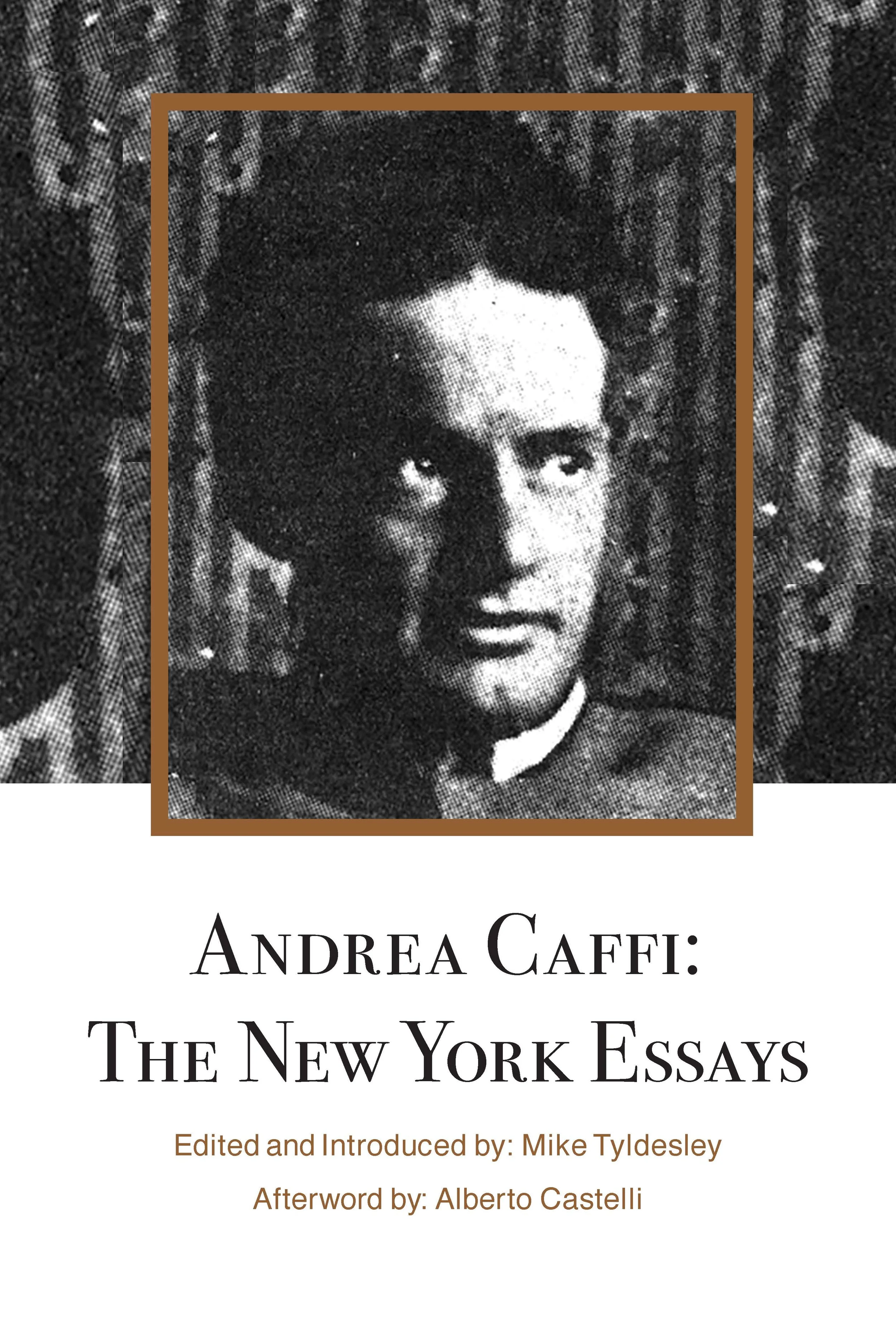
Andrea Caffi: The New York Essays

$22.00

Andrea Caffi: The New York Essays gathers, for the first time in one volume, the remarkable essays that the Russian-born Italian socialist Andrea Caffi (1887-1955) published in New York between 1945 and 1948. Written in the shadow of fascism, world war, and the emerging Cold War, these essays offer a powerful and original critique of violence, mass politics, nationalism, and totalitarianism.

Appearing in influential journals such as politics, possibilities, and Instead, Caffi's work engages directly with leading figures of the New York intellectual milieu, including Dwight Macdonald and Nicola Chiaromonte. Across topics ranging from revolutionary war and mass culture to mythology, Marxism, and the fate of Europe, Caffi articulates a vision of socialism rooted not in state power or organized violence, but in sociability, moral responsibility, and the renewal of civic life.

At once philosophical, historical, and urgently political, Caffi's essays challenge both liberal and Marxist orthodoxies. They speak to enduring questions about the relationship between means and ends, the dangers of ideological conformity, and the possibility of freedom in an age of mass society.

With a substantial introduction by Mike Tyldesley and an afterword by Alberto Castelli situating Caffi's thought within twentieth-century antifascism and the critique of political violence, this volume restores to contemporary readers one of Europe's most subtle and neglected radical thinkers.

Andrea Caffi: The New York Essays gathers, for the first time in one volume, the remarkable essays that the Russian-born Italian socialist Andrea Caffi (1887-1955) published in New York between 1945 and 1948. Written in the shadow of fascism, world war, and the emerging Cold War, these essays offer a powerful and original critique of violence, mass politics, nationalism, and totalitarianism.

Appearing in influential journals such as politics, possibilities, and Instead, Caffi's work engages directly with leading figures of the New York intellectual milieu, including Dwight Macdonald and Nicola Chiaromonte. Across topics ranging from revolutionary war and mass culture to mythology, Marxism, and the fate of Europe, Caffi articulates a vision of socialism rooted not in state power or organized violence, but in sociability, moral responsibility, and the renewal of civic life.

At once philosophical, historical, and urgently political, Caffi's essays challenge both liberal and Marxist orthodoxies. They speak to enduring questions about the relationship between means and ends, the dangers of ideological conformity, and the possibility of freedom in an age of mass society.

With a substantial introduction by Mike Tyldesley and an afterword by Alberto Castelli situating Caffi's thought within twentieth-century antifascism and the critique of political violence, this volume restores to contemporary readers one of Europe's most subtle and neglected radical thinkers.

Endorsements

“The time is ripe for “rediscovering” Andrea Caffi–in much the same way new attention is lately being paid to his close friend, Nicola Chiaromonte. Caffi is an elusive subject, having managed a precarious existence in defiance of Czarists and Bolsheviks in Russia, Fascist enforcers in Italy, and the Gestapo in occupied France. For Chiaromonte he was a model of “what it means to live as a free man in a world where success and power hold sway.” Mike Tyldesley opens the door for us with these letters and essays published in New York just after WWII, most notably in Dwight MacDonald’s remarkable politics magazine. As  we  face  today’s dehumanizing forces, the ideas expressed here–about “sociability” and the need for dialogue, outside mass institutions and across cultural boundaries–offer a rich source of inspiration and hope.”

Gregory Sumner

Professor of History, University of Detroit Mercy, Author ofDwight MacDonald and the politics Circle.

“Andrea Caffi was no ordinary thinker. Libertarian socialist, radical federalist, and fierce critic of violence, he stood as one of the last true hommes de lettres.

The New York Essays, edited by Mike Tyldesley, reveal a voice shaped by two world wars, the betrayal of Russian Revolution, and the rise of fascism. His reflections–ignored in his own time and sidelined by Cold War binaries–speak powerfully to our present, in an age of resurgent nationalism and democratic decline.

Caffi may still offer us a lesson we would do well not to ignore.”

Daniele Bassi

Hannah Arendt Centre for Political Studies – University o f Verona , Author o f L'Altra Tradizione: Violenza e potere in Andrea Caffi e Hannah Arendt.

“This annotated collection gathers Andrea Caffi’s New York essays—some overlooked, others more familiar—into one compelling volume. A rich resource for those exploring the transatlantic intellectual currents of the 20th century, it brings Caffi’s nuanced insights into the contemporary spotlight for English-speaking readers.”

Amanda Swain

IES Abroad, Editor of forthcoming collection of Chiaromonte's correspondence.